

How cross-functional pods bridge the gap from idea to impact
Use cross-functional Discovery Pods to align your team, validate concepts, and turn ideas into actionable roadmaps.
We’ve all seen how many AI projects stall out. It’s frustrating because they often begin with a great idea but lose momentum when the business team and the tech team aren’t on the same page. This disconnect is a classic issue: leadership focuses on the big picture, the engineering team builds something different, and by the time you involve Legal, you’re already behind.
When teams work in isolation, relying on layered approval processes and then handing off to engineering, assumptions build up. By the time you start building, things may have changed, or you might find that the data doesn’t support the idea. We’ve covered previously why AI tools fail without a structured workflow, and the root cause is almost always the same: a lack of unified process.
To bridge the gap between idea and impact, high-performing teams have stopped using standard sequential handoffs. They now use what is called “Discovery Pods."
What’s a Discovery Pod?
A Discovery Pod is the opposite of an endless, sprawling committee meeting. It’s just a group of six to eight people who really need to be there, gathered for one specific, temporary mission: to figure out if an AI challenge is worth solving, create a quick prototype, and validate it with real users before anyone invests in production infrastructure.
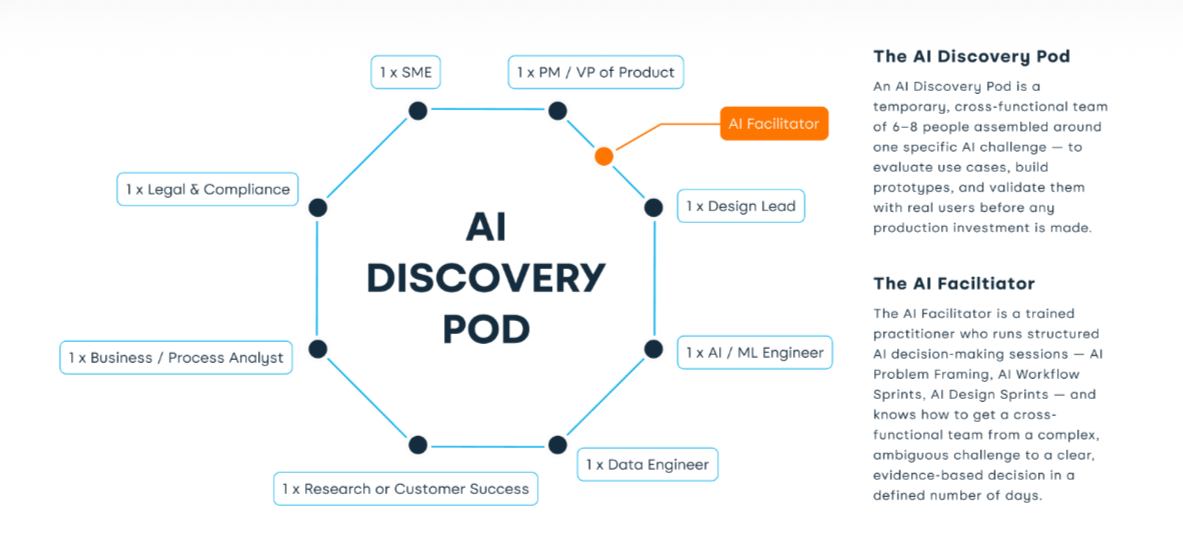
The structure works because it brings the right people together. You need a Decider, often a Product Lead or VP, to make crucial decisions, domain experts to keep the project focused, and engineers to explain what’s actually feasible. Designers add the human perspective, and Legal ensures you avoid any pitfalls. This mix fosters cognitive diversity. When those who know the workflow communicate directly with those who understand the code, misunderstandings are resolved early instead of becoming costly obstacles months later.
You need a neutral person to facilitate the discussions, someone outside the team’s hierarchy. This is the AI Facilitator. Think of them as a referee. Without this role, meetings can turn into debates where the loudest voice wins or where everyone gets distracted by the latest AI trends, forgetting about the real challenges of building the tech. A good facilitator keeps the team grounded in what’s factual, not just what sounds appealing.
How to assemble your pod
You don't need a massive team. In fact, size is the enemy of speed. To build a high-functioning pod, keep it lean and follow these four steps:
- Identify the Decider: Every pod needs one person with the authority to make the final call. Without a clear decision-maker, the group will spin in circles debating options rather than picking the best path forward.
- Curate the mix: Invite only those essential to validating the specific problem. You want a balance of technical feasibility (Engineers), human utility (Designers), and business viability (Domain Experts). If you have more than eight people, you have a meeting, not a pod.
- Appoint a neutral facilitator: This person must sit outside the project hierarchy. They aren't there to contribute their own ideas, but to force the team to confront the evidence. They act as the referee to ensure the loudest voice doesn't drown out the best data.
- Set a tight time-box: Don't leave the discovery period open-ended. A pod should have a fixed, short duration (e.g., 1-2 weeks) to force prioritization. If you can’t validate the concept in that time, you aren't ready for production.
Need a framework for alignment? Explore our training & events to synchronize your team’s vision before the build begins.
Validation over infrastructure
To stop wasting time, you have to change how you look at risk. By getting everyone in a room early, you spot the deal-breakers before you actually start writing code. It turns out that over half of AI projects get abandoned after the prototype phase, usually because of messy data, spiraling costs, or because no one really knows why the project exists in the first place. It happens because companies try to tack AI onto their existing setup, rather than actually rethinking how their team works.
Finding out a model isn't viable in week two is a massive win. Finding that out after you’ve spent six months building infrastructure is a career-limiting move.
These pods borrow from Agile, but they adapt it for the high-uncertainty nature of AI. They focus on speed, shared understanding, and brutal honesty. If the pod does its job, the production team begins work from a position of reality. There’s no guesswork involved.
Moving from discovery to execution
There is a common misconception that "Discovery" just means brainstorming. In the context of AI, discovery is actually a high-stakes engineering and design exercise.
Essentially, a Discovery Pod aims to produce tangible outcomes: a validated user journey, a data dependency map, and a technical feasibility audit. This output serves as the foundation for the production team. By the time the Discovery Pod wraps up, you should have a clear “how.” You’ve outlined the integration points, detected legal constraints, and demonstrated the value. This clarifies the AI project into a straightforward software roadmap that your engineering teams can follow.
Remember, as you create that roadmap, focus on determining what to automate and what to own so your resources remain centered on high-value projects.
Ready to stop the cycle of failed experiments? Let us act as your AI Facilitator to organize your discovery pods and turn your ideas into validated plans. Schedule a call with our team.